With the sad passing of John Berger at the beginning of the
year, I thought that as a mark of respect to his life-time’s work and his
contribution to the art world, that I would highlight some of the books held by
the Library which are just a few examples of John’s work.
John Peter Berger, born in 1926, was an English art critic,
novelist, painter and poet. His novel G. won the 1972 Booker Prize, and his
essay on art criticism Ways of Seeing, written as an accompaniment to a BBC
series, is often used as a university text.
The art critic, essayist and novelist John Berger threw down
his challenge early in his television series Ways of Seeing. This came in 1972,
the year when Berger, who has died aged 90, broke through to real fame from his
niche celebrity on the arts pages of the New Statesman. Ways of Seeing, made on
the cheap for the BBC as four half-hour programmes, was the first series of its
kind since Civilisation (1969), 13 one-hour episodes for which Kenneth
Clark, its writer and presenter, and a BBC production team had traveled 80,000
miles through 13 countries exploring 2,000 years of the visual culture of the
western world. Berger traveled as far as the hut in Ealing, west London where
his programmes were filmed, and no farther. What he said in his characteristic
tone of sweet reasonableness was: “In his book on the nude, Kenneth Clark says that being
naked is simply being without clothes. The nude, according to him, is a form of
art. I would put it differently: to be naked is to be oneself; to be nude is to
be seen naked by others and yet not recognised for oneself. A nude has to be
seen as an object in order to be a nude.” In other words, art is a commodity and a woman in art is an
object. No approach to art could have been more different from Clark’s
gentlemanly urbanity.
These demotic programmes turned Berger into the hero of a
generation studying the burgeoning new university courses on European visual
culture. The spin-off book was never out of print.
Ways of Seeing 701 BER
How do we see the world around us? "Seeing comes before
words. The child looks and recognizes before it can speak." "But there is also another sense in which seeing comes
before words. It is seeing which establishes our place in the surrounding
world; we explain that world with words, but word can never undo the fact that
we are surrounded by it. The relation between what we see and what we know is
never settled." John Berger's Ways of Seeing is one of the most
stimulating and influential books on art in any language. First published in
1972, it was based on the BBC television series about which the (London) Sunday
Times critic commented: "This is an eye-opener in more ways than one: by
concentrating on how we look at paintings . . . he will almost certainly change
the way you look at pictures." By now he has.

Understanding a photograph 770 BER
The unique combination of critic and photographer results in a work that moves beyond the landmarks established by Walter Benjamin, Roland Barthes and Susan Sontag to establish a new theory of photography. When John Berger wrote this apparently unclassifiable book, it was to become a
sensation, translated into nine languages and indelible from the minds of those
who read it. This stunning work is a shoebox filled with delicate love letters
containing poetry and thoughts on mortality, art, love and absence, capturing moments
in time that hover above Berger's surprising landscapes. From his lyrical
description of the works of Caravaggio and profound explorations of death and
immigration to the sight of some lilac at dusk in the mountains, this is a
beautiful and most intimate response to the world around us.
Permanent Red : Essays in Seeing 701 BER
These essays by John
Berger had their origins in articles written for publication in periodicals,
particularly The New Statesman. They have now, however been so thoroughly
thought over, revised and expanded that they form a consistent whole. This is
not a haphazard selection of the best of Berger but a systematic attempt to
place contemporary art in a critical perspective.
About looking 701 BER

As a novelist, essayist, and cultural historian, John Berger
is a writer of dazzling eloquence and arresting insight whose work amounts to a
subtle, powerful critique of the canons of our civilization. In About
Looking he explores our role as observers to reveal new layers of meaning
in what we see. How do the animals we look at in zoos remind us of a
relationship between man and beast all but lost in the twentieth century? What
is it about looking at war photographs that doubles their already potent
violence? How do the nudes of Rodin betray the threats to his authority and
potency posed by clay and flesh? And how does solitude inform the art of
Giacometti? In asking these and other questions, Berger alters the vision of
anyone who reads his work.
 Another way of
telling: a possible theory of photography 770 BER
Another way of
telling: a possible theory of photography 770 BER
In one of the most eloquent accounts of
photography ever devised (originally published in 1982 and unavailable for many
years), the writer John Berger and the photographer Jean Mohr set out to understand
the fundamental nature of photography and how it makes its impact.
Asking a range of questions – What is a photograph? What do photographs mean?
How can they be used? – they give their answers in terms of a photograph as 'a
meeting place where the interests of the photographer, the photographed, the
viewer and those who are using the photography are often contradictory'. From
these beginnings they develop a theory of photography that has at its centre
the form's essential ambiguity, arguing that photography is totally unlike a
film and has nothing to do with reportage. Rather, it constitutes 'another way
of telling'. The unique combination of critic and photographer results in a work that moves
beyond the landmarks established by Walter Benjamin, Roland Barthes and Susan
Sontag to establish a new theory of photography.
 And Our Faces, My
Heart, Brief as Photos 828.91409 BER
And Our Faces, My
Heart, Brief as Photos 828.91409 BER
'Those who read or listen to our stories see everything as
though through a lens. This lens is the secret of narration, and it is ground
anew in every story, ground between the temporal and the timeless ... In our
brief mortal lives, we are grinders of these lenses'.
Art and revolution :Ernst Neizvestny and the role of the artist in the USSR 759.7 BER
In this prescient and beautifully written book, John Berger
examines the life and work of Ernst Neizvestny, a Russian sculptor whose
exclusion from the ranks of officially approved Soviet artists left him
laboring in enforced obscurity to realize his monumental and very public vision
of art. But Berger's impassioned account goes well beyond the specific dilemma
of the pre-glasnot Russian artist to illuminate the very meaning of
revolutionary art. In his struggle against official orthodoxy--which involved a
face-to-face confrontation with Khruschev himself--Neizvestny was fighting not
for a merely personal or aesthetic vision, but for a recognition of the true
social role of art. His sculptures earn a place in the world by reflecting the
courage of a whole people, by commemorating, in an age of mass suffering, the
resistance and endurance of millions.
 Berger on Drawing 741.0118 BER
A series of essays from a sensitive writer. Not on how to
draw but getting at obliquely why we draw & how drawing can function for
us. Everybody should draw to live vividly (forget so-called 'talent' - and
abandon the childish need to make a pleasing drawing for others - just draw
honestly and keep drawing - become involved in the visual world and strangely
lay down memories that include sounds, feelings external & internal,
smells...
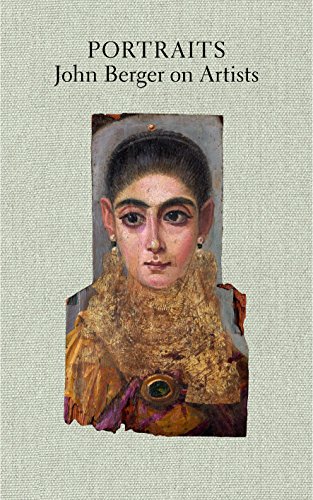
 Portraits: John
Berger on artists 704.942
BER
Portraits: John
Berger on artists 704.942
BER
A major new book from one of the world’s leading writers and
art critics John Berger, one of the world’s most celebrated art writers,
takes us through centuries of drawing and painting, revealing his lifelong
fascination with a diverse cast of artists. In Portraits, Berger grounds the
artists in their historical milieu in revolutionary ways, whether enlarging on
the prehistoric paintings of the Chauvet caves or Cy Twombly’s linguistic and
pictorial play. In penetrating and singular prose, Berger presents entirely
new ways of thinking about artists both canonized and obscure, from Rembrandt
to Henry Moore, Jackson Pollock to Picasso. Throughout, Berger maintains the
essential connection between politics, art and the wider study of culture. The
result is an illuminating walk through many centuries of visual culture, from
one of the contemporary world’s most incisive critical voices.
Landscapes: John
Berger on Art 700 BER
With Portraits, world-renowned art writer John Berger took
us on a captivating journey through centuries of art, situating each artist in
the proper political and historical contexts. In Landscapes, a narrative of
Berger’s own journey emerges. Through his penetrating engagement with the
writers and artists who shaped his own thought, Walter Benjamin, Rosa Luxemburg
and Bertolt Brecht among them, Landscapes allows us to understand how Berger
came to his own way of seeing. As always, Berger pushes at the limits of art
writing, demonstrating beautifully how his painter’s eyes lead him to refer to
himself only as a storyteller. A landscape is, to John Berger, like a portrait,
an animating, liberating metaphor rather than a rigid definition. It’s a term,
too, that reminds us that there is more here than simply the backdrop or
‘by-work’ of a portrait. Landscapes offers a tour of the history of art, but
not as you know it.
 The moment of Cubism
: and other essays 709.04032
BER
The moment of Cubism
: and other essays 709.04032
BER

A collection of essays by John Berger, who is as usual
provocative and thought provoking. He has a unique way of looking at art that
forces us to engage with art on a different level.
The success and
failure of Picasso
759 PIC
In this classic of art criticism, one of our foremost
cultural historians grapples with the life and work of one of the twentieth
century's most mercurial and prodigious artists. In The Success and
Failure of Picasso, John Berger places the artist in the historical, social and
political contexts that made his work possible.
 A Seventh Man, a book
of images and words about the experience of
A Seventh Man, a book
of images and words about the experience of
Migrant
Workers in Europe 301.55 BER
Why does the Western world look to migrant labourers to
perform the most menial tasks? What compels people to leave their homes and
accept this humiliating situation? In A Seventh Man, John Berger and Jean Mohr
come to grips with what it is to be a migrant worker the material circumstances
and the inner experience and, in doing so, reveal how the migrant is not so
much on the margins of modern life, but absolutely central to it. First
published in 1975, this finely wrought exploration remains as urgent as ever,
presenting a mode of living that pervades the countries of the West and yet is
excluded from much of its culture.
 The Shape of a Pocket 330.122 BER
John Berger writes: 'The pocket in question is a small
pocket of resistance. A pocket is formed when two or more people come together
in agreement. The resistance is against the inhumanity of the new world
economic order. The people coming together are the reader, me and those the
essays are about - Rembrandt, Palaeolithic cave painters, a Romanian peasant,
ancient Egyptians, an expert in the loneliness of certain hotel bedrooms, dogs
at dusk, a man in a radio station. And unexpectedly, our exchanges strengthen
each of us in our conviction that what is happening to the world today is
wrong, and that what is often said about it is a lie. I've never written a book
with a greater sense of urgency.'
A jar of wild flowers
: essays in celebration of John Berger 828.91409
GUN

In this collection of essays on the work of, and
conversations with, John Berger, thirty-seven of his friends, artistic
collaborators and followers come together to form the first truly international
and cross-cultural celebration of his interventions. Berger has for decades, through his poetic humanism, brought
together geographically, historically and socially disparate subjects. His work
continues to throw out lifelines across genres, times and types of experience, opening
up radical questions about the meaning of belonging and of community. In
keeping with this spirit and in celebration of Berger, the short essays in A
Jar of Wild Flowers challenge us all to take the brave step from limited
sympathy to extended generosity.
And finally…….
 DVD John Berger: The
Art of Looking (BBC4 Jan 2017) 701 BER
DVD John Berger: The
Art of Looking (BBC4 Jan 2017) 701 BER
Art, politics and motorcycles - on the occasion of his 90th
birthday, this is an intimate portrait of the late writer and art critic whose
groundbreaking work on seeing has shaped our understanding of the concept
for over five decades. The film explores how paintings become narratives and
stories turn into images, and rarely does anybody demonstrate this as
poignantly as Berger.
Berger lived and worked for decades in a small mountain
village in the French Alps, where the nearness to nature, the world of the
peasants and his motorcycle, which for him deals so much with presence,
inspired his drawing and writing.
The film introduces Berger's art of looking with theatre wizard
Simon McBurney, film director Michael Dibb, visual artist John Christie,
cartoonist Selçuk Demiral and photographer Jean Mohr, as well as two of his
children - film critic Katya Berger and the painter Yves Berger.
The prelude and starting point is Berger's mind-boggling
experience of restored vision following a successful cataract removal surgery.
There, in the cusp of his clouding eyesight, Berger re-discovers the
irredeemable wonder of seeing. Realised as a portrait in works and collaborations, this creative
documentary takes a different approach to biography, with Berger leading in his
favourite role of the storyteller.
 JB Quotes
Nakedness reveals itself. Nudity is placed on display. The
nude is condemned to never being naked. Nudity is a form of dress.
Men act and women appear. Men look at women. Women watch
themselves being looked at.
Glamour cannot exist without personal social envy being a
common and widespread emotion.


 Wabi-sabi for artists, designers, poets & philosophers / by Leonard Koren. (1994)





 Today Carrington is recognised as the key female Surrealist
painter, for a time Max Ernst's lover in Paris, Carrington rubbed shoulders
with Salvador Dalí, Marcel Duchamp, Joan Miró, André Breton and Pablo Picasso.
When Ernst fled Paris at the outbreak of the Second World War, Carrington had a
breakdown and was locked away in a Spanish asylum before escaping to Mexico,
where she would work on the paintings which made her name.
Today Carrington is recognised as the key female Surrealist
painter, for a time Max Ernst's lover in Paris, Carrington rubbed shoulders
with Salvador Dalí, Marcel Duchamp, Joan Miró, André Breton and Pablo Picasso.
When Ernst fled Paris at the outbreak of the Second World War, Carrington had a
breakdown and was locked away in a Spanish asylum before escaping to Mexico,
where she would work on the paintings which made her name. 
 Carrington remained committed to Surrealism throughout
her career, filling her pictures with strange or fantastic creatures in
surprising situations, notably horses, which appear in Self-portrait, as
well as unicorns, owls, dogs and lizards; she sometimes also combined features
of animals and human beings. Her references were wide-ranging, whether to
ancient Babylonian, Assyrian and Egyptian mythology or to visions reminiscent
of the Middle Ages. The strange, enigmatic and subtly humorous anecdotes that
appear in her work were the expression of a profound inner world, a mythology
of her own making, which although terrifying protected her from the aggressive
banality of the external world. A prolific painter, she combined technical
refinement with a careful but at the same time extremely free design.
Carrington remained committed to Surrealism throughout
her career, filling her pictures with strange or fantastic creatures in
surprising situations, notably horses, which appear in Self-portrait, as
well as unicorns, owls, dogs and lizards; she sometimes also combined features
of animals and human beings. Her references were wide-ranging, whether to
ancient Babylonian, Assyrian and Egyptian mythology or to visions reminiscent
of the Middle Ages. The strange, enigmatic and subtly humorous anecdotes that
appear in her work were the expression of a profound inner world, a mythology
of her own making, which although terrifying protected her from the aggressive
banality of the external world. A prolific painter, she combined technical
refinement with a careful but at the same time extremely free design. 50 British Artists
You Should Know
50 British Artists
You Should Know  The Artist's Joke
  Black Mirror 1 – Embodiment
  Intersections : women
artists/surrealism/modernism
Intersections : women
artists/surrealism/modernism  Women Artists and the
Surrealist Movement
Women Artists and the
Surrealist Movement


 Mark Grotjahn
  The Library recently
purchased the exhibition catalogue of Mark Grotjahn’s Circus Circus, produced
on the occasion of an exhibition held at Kunstverein Freiburg, May 16 - July
27, 2014.
The Library recently
purchased the exhibition catalogue of Mark Grotjahn’s Circus Circus, produced
on the occasion of an exhibition held at Kunstverein Freiburg, May 16 - July
27, 2014.

 Mark Grotjahn : Circus Circus
 The forever now : contemporary painting in an
atemporal world
The forever now : contemporary painting in an
atemporal world Art Now Volume 2 : The new directory to 136
international contemporary artists
Art Now Volume 2 : The new directory to 136
international contemporary artists L'Avventura - (1960)
[DVD]
L'Avventura - (1960)
[DVD]


 As a novelist, essayist, and cultural historian, John Berger
is a writer of dazzling eloquence and arresting insight whose work amounts to a
subtle, powerful critique of the canons of our civilization. In About
Looking he explores our role as observers to reveal new layers of meaning
in what we see. How do the animals we look at in zoos remind us of a
relationship between man and beast all but lost in the twentieth century? What
is it about looking at war photographs that doubles their already potent
violence? How do the nudes of Rodin betray the threats to his authority and
potency posed by clay and flesh? And how does solitude inform the art of
Giacometti? In asking these and other questions, Berger alters the vision of
anyone who reads his work.
As a novelist, essayist, and cultural historian, John Berger
is a writer of dazzling eloquence and arresting insight whose work amounts to a
subtle, powerful critique of the canons of our civilization. In About
Looking he explores our role as observers to reveal new layers of meaning
in what we see. How do the animals we look at in zoos remind us of a
relationship between man and beast all but lost in the twentieth century? What
is it about looking at war photographs that doubles their already potent
violence? How do the nudes of Rodin betray the threats to his authority and
potency posed by clay and flesh? And how does solitude inform the art of
Giacometti? In asking these and other questions, Berger alters the vision of
anyone who reads his work. Another way of
telling: a possible theory of photography 770 BER
Another way of
telling: a possible theory of photography 770 BER And Our Faces, My
Heart, Brief as Photos 828.91409 BER
And Our Faces, My
Heart, Brief as Photos 828.91409 BER  Berger on Drawing 741.0118 BER
 Portraits: John
Berger on artists 704.942
BER
Portraits: John
Berger on artists 704.942
BER
 The moment of Cubism
: and other essays 709.04032
BER
The moment of Cubism
: and other essays 709.04032
BER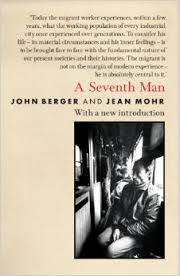 A Seventh Man, a book
of images and words about the experience of
A Seventh Man, a book
of images and words about the experience of  The Shape of a Pocket 330.122 BER
 In this collection of essays on the work of, and
conversations with, John Berger, thirty-seven of his friends, artistic
collaborators and followers come together to form the first truly international
and cross-cultural celebration of his interventions. Berger has for decades, through his poetic humanism, brought
together geographically, historically and socially disparate subjects. His work
continues to throw out lifelines across genres, times and types of experience, opening
up radical questions about the meaning of belonging and of community. In
keeping with this spirit and in celebration of Berger, the short essays in A
Jar of Wild Flowers challenge us all to take the brave step from limited
sympathy to extended generosity.
In this collection of essays on the work of, and
conversations with, John Berger, thirty-seven of his friends, artistic
collaborators and followers come together to form the first truly international
and cross-cultural celebration of his interventions. Berger has for decades, through his poetic humanism, brought
together geographically, historically and socially disparate subjects. His work
continues to throw out lifelines across genres, times and types of experience, opening
up radical questions about the meaning of belonging and of community. In
keeping with this spirit and in celebration of Berger, the short essays in A
Jar of Wild Flowers challenge us all to take the brave step from limited
sympathy to extended generosity.  DVD John Berger: The
Art of Looking (BBC4 Jan 2017) 701 BER
DVD John Berger: The
Art of Looking (BBC4 Jan 2017) 701 BER

