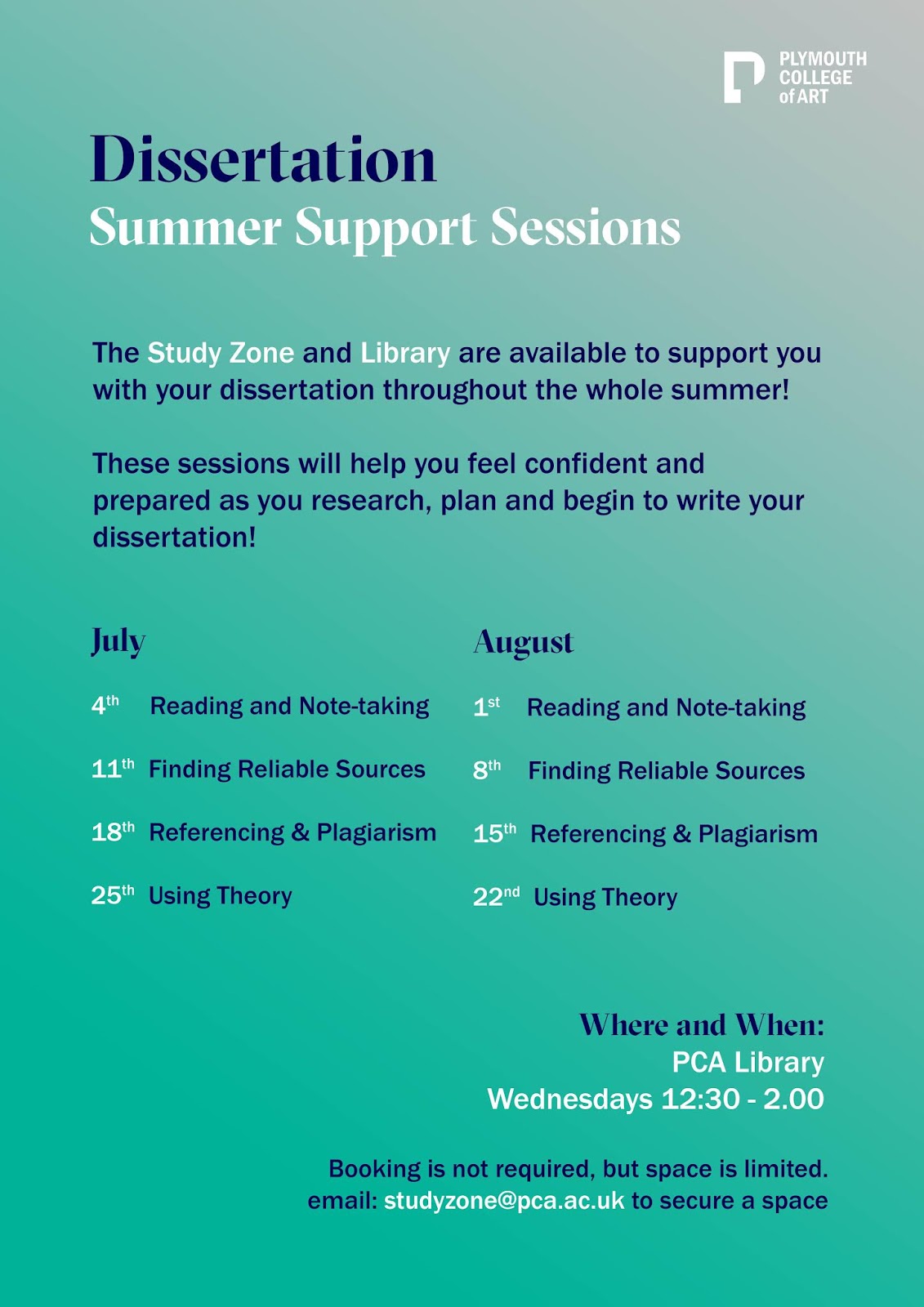
Want to get a head start on your dissertation? Come along to our Summer Dissertation Support Sessions!
The Library and Study Zone are joining forces to put on sessions to teach you how to find resources, read and take take notes, reference and use theory!
Showing posts with label HE_Graphic_Design. Show all posts
Tuesday, 3 July 2018
Friday, 20 April 2018
A History of Screen Printing.
This is a comprehensive guide to the history of screen printing, and has some wonderful examples of screen printed work, from advertising and mass production, to recreation of art works.
You can find it at 764 LEN
Wednesday, 14 March 2018
Beautiful Book Covers!
The illustrated dust jacket 1920-1970
Martin Salisbury. (2017)
The middle decades of the twentieth century saw an extraordinary flourishing of the illustrated, pictorial dust jacket. From the 1920s, as the potential for the book’s protective wrapping to be used for promotion and enticement became clear, artists and illustrators on both sides of the Atlantic applied their talents to this particular art form. Rising to the wide-ranging challenges posed by format and subject matter, leading artists and illustrators, including John Piper, Edward Bawden and John Minton in the UK and Ben Shahn, Edward Gorey and George Salter in the USA, brought their unique personal vision to bear on the world of books. Many of their designs reflect the changing visual styles and motifs of the period, including Bloomsbury, Art Deco, Modernism, postwar neo-romanticism and the Kitchen Sink School.
Martin Salisbury has selected over fifty of the artists and illustrators who were active in the period 1920–1970 in the UK and USA, as well as others such as Tove Jansson and Celestino Piatti, and discusses their life and work. A selection of dust jackets – both known and too long forgotten – for each artist reveals how far the book as an artefact had travelled from the days of the plain wrapper in the nineteenth century.
Monday, 6 November 2017
Book of the Week.
This week, our book of the week comes from Illustration alumni Isaac Lenkiewicz.
A Castle in England, 741.5941 RHO
A collaboration between writer Jamie Rhodes and the National Trust, this unique graphic novel plunges us into the rich and often dark history of Scotney Castle in Kent.
Recreating the castle’s past from the Medieval to the Edwardian ages, five rising stars from the UK comics scene (Isaac Lenkiewicz, Briony May Smith, William Exley, Becky Palmer and Isabel Greenberg) have illustrated five short stories that mix fiction with fact, creating a visually striking graphic collection that is steeped in historical context.
See this on our new books stand today! #plymouthcollegeofartlibrary
Monday, 9 October 2017
Typography Titles.
How to Draw Type and Influence People : An Activity Book / Sarah Hyndman. (2017)
686.224 HYN


We are all type consumers and interact with type in our everyday lives. Typefaces in all shapes and sizes evoke an emotional response and trigger associated memories before we've even read the words. How to Draw Type and Influence People shows how we use type to understand different messages. Each typeface is introduced and explained and then creative exercises show the reader how to draw each font and invite them to explore the associations evoked by the styles, to reveal why they have come about and how to create their own versions. Ideal for all those who work with type daily, this book provides an accessible way in to the world of typefaces, for the general reader, but also graphic designers who want to explore fonts in more detail and design their own letterforms.
The visual history of type / Paul McNeil. (2017)
686.22 MCN

'The Visual History of Type' is a comprehensive, detailed survey of the major typefaces produced since the advent of printing with movable type in the mid-fifteenth century to the present day. Arranged chronologically to provide context, more than 320 typefaces are displayed in the form of their original type specimens or earliest printing. Each entry is supported by a brief history and description of key characteristics of the typeface. This book will be the definitive publication in its
686.224 HYN


We are all type consumers and interact with type in our everyday lives. Typefaces in all shapes and sizes evoke an emotional response and trigger associated memories before we've even read the words. How to Draw Type and Influence People shows how we use type to understand different messages. Each typeface is introduced and explained and then creative exercises show the reader how to draw each font and invite them to explore the associations evoked by the styles, to reveal why they have come about and how to create their own versions. Ideal for all those who work with type daily, this book provides an accessible way in to the world of typefaces, for the general reader, but also graphic designers who want to explore fonts in more detail and design their own letterforms.
The visual history of type / Paul McNeil. (2017)
686.22 MCN

'The Visual History of Type' is a comprehensive, detailed survey of the major typefaces produced since the advent of printing with movable type in the mid-fifteenth century to the present day. Arranged chronologically to provide context, more than 320 typefaces are displayed in the form of their original type specimens or earliest printing. Each entry is supported by a brief history and description of key characteristics of the typeface. This book will be the definitive publication in its
Friday, 22 September 2017
New Illustration Titles!
Graphic novels: everything you need to know / Paul Gravett.

741.5 GRA
Featuring striking graphics and explanatory extracts from a wide range of graphic novels, the book examines the specific language of the comics medium; the history and pioneers of the form; recent masterpieces from Art Spiegelman's Maus to Chris Ware's Jimmy Corrigan; the impact of Japanese manga and European albums translated into English; how artists have overcome prejudices towards the genre; and the ambitious range of themes and issues artists are addressing, including childhood, war and survival, politics, the future, sexuality, and the supernatural.
Colour / Marion Deuchars.
701.85 DEU
What makes a colour work? What do colours mean to artists or cultures? Why does grey make a colour stand out? What colour are the oceans? Why is the yellow of lemons something to treasure?
Award-winning illustrator Marion Deuchars takes us on a journey through colour, showing how its language is at the centre of how we think and feel about the world. Colour is everywhere. Through this book, we can see it afresh. With beautiful hand rendered type!
The market for illustration is changing. How can illustrators survive and thrive? Illustration students, educators, and working artists will find illuminating commentary on editorial, graphic novels, comics, animations, Web, games, toys, fashion, textiles, and more, along with an exploration of how old platforms have changed and new ones emerged. Fifty working illustrators, including such top names as Christoph Niemann, Alex Murawski, Jashar Awan, Yuko Shimuzo, and Tomer Hanuka, share insights on what works now. Published in association with the School of Visual Arts, Marketing Illustration explores the impact of technology and the future of the illustration market. No illustrator can afford to miss this thought-provoking resource.
Tuesday, 14 February 2017
A Small Selection of Brand New Great Graphic Design Books to Borrow from the Library
Graphic design in urban
environments
Graphic Design
in Urban Environments introduces the idea of a category of designed graphic
objects that significantly contribute to the functioning of urban systems.
These elements, smaller than buildings, are generally understood by urban
designers to comprise such phenomena as sculpture, clock towers, banners,
signs, large screens, the portrayal of images on buildings through "smart
screens,†? and other examples of what urban designers call "urban
objects.†?The graphic object as it is defined here also refers to a range of
familiar things invariably named in the literature as maps, street numbers,
route signs, bus placards, signs, architectural communication, commercial
vernacular, outdoor publicity, lettering, banners, screens, traffic and
direction signs and street furniture. One can also add markings of a sports
pitch, lighting, bollards, even red carpets or well dressings.
By looking at the environment, and design and deconstructing form and context relationships, the defining properties and configurational patterns that make up graphic objects are shown in this book to link the smallest graphic detail (e.g. the number 16) to larger symbolic statements (e.g. the Empire State Building). From a professional design practice perspective, a cross section through type, typographic, graphic and urban design will provide a framework for considering the design transition between alphabets, writing systems, images (in the broadest sense) and environments.

By looking at the environment, and design and deconstructing form and context relationships, the defining properties and configurational patterns that make up graphic objects are shown in this book to link the smallest graphic detail (e.g. the number 16) to larger symbolic statements (e.g. the Empire State Building). From a professional design practice perspective, a cross section through type, typographic, graphic and urban design will provide a framework for considering the design transition between alphabets, writing systems, images (in the broadest sense) and environments.

Arabic for designers
686.21927 BOU
"With more
than 200 examples of the best in contemporary Arabic typography and graphic
design, Arabic for Designers is an illustrated primer on how to work with
Arabic and understand and respect its cultural nuances. The worlds of business
and communications rely more and more on the cross-hybridization of Latin and
Arabic graphic design approaches. As the book reveals, it is a process that can
yield incredibly innovative, beautiful and successful results. Without the
proper knowledge, however, creative campaigns and endeavors, not to mention the
money invested for such efforts, can easily be lost." "Visual
examples and case studies span the range of graphic design applications -
newspaper and television news typefaces, book jacket designs, logotype conversions,
posters and art. Designers of all sorts will have a guide to proceed with their
own projects. Arabic for Designers is the first book of its kind to delve into
these issues in a way that makes itself useful for non-Arabic speaking graphic
designers regardless of their industry, ability or level of experience."
741.6 HEL
This book
serves as an introduction to the key elements of good design. Broken into
sections covering the fundamental elements of design, key works by acclaimed
designers serve to illustrate technical points and encourage readers to try out
new ideas. Themes covered include narrative, colour, illusion, ornament,
simplicity, and wit and humour. The result is an instantly accessible and easy
to understand guide to graphic design using professional techniques.
702.812 DRM
Curated by Ryan
Doyle and Mark Edwards, who work together under the name of DR.ME, Cut That Out
focuses on the compositions of 50 leading designers and studios from 15
different countries for whom collage has been the key to creating vibrant,
effective work – among them Hort, Paul Sahre and atelier bingo. As well as the
diverse, cutting-edge work featured throughout, each profile includes a Q&A
with the artist that serves to both put the work in context and highlight the
visual differences between each designer by exploring their varying methods and
attitudes towards to Cut That Out is a rich seam of inspiration to be mimed by
all students and graphic designers who wish to explore the creative
possibilities of collage in their work.


Naïve : modernism and
folklore in contemporary graphic design
741.6 KLA
"A
minimalist design vocabulary is currently being reinvented by a troop of young
graphic designers who are rediscovering the stylistic elements reminiscent of
classic graphic design such as silkscreen printing, classical typography and
folk art and integrating them into their work. Naive documents this
extraordinary renaissance of Classic Modernism, from the 1940s to 1960s, in
contemporary graphic design."
Graphic design thinking
: beyond brainstorming
741.6 LUP
Creativity is
more than an inborn talent; it is a hard-earned skill, and like any other
skill, it improves with practice. Graphic Design Thinking: How to Define
Problems, Get Ideas, and Create Form explores a variety of informal techniques
ranging from quick, seat-of-the-pants approaches to more formal research
methods for stimulating fresh thinking, and ultimately arriving at compelling
and viable solutions. In the style with which author Ellen has come to been
known hands-on, up-close approach to instructional design writing brainstorming
techniques are grouped around the three basic phases of the design process:
defining the problem, inventing ideas, and creating form. Creative research
methods include focus groups, interviewing, brand mapping, and co-design. Each
method is explained with a brief narrative text followed by a variety of visual
demonstrations and case studies. Also included are discussions with leading
professionals, including Art Chantry, Ivan Chermayeff, Jessica Helfand, Steven
Heller, Abott Miller, Christoph Niemann, Paula Scher, and Martin Venezky, about
how they get ideas and what they do when the well runs dry. The book is
directed at working designers, design students, and anyone who wants to apply
inventive thought patterns to everyday creative challenges.
741.6 POY
Seven years
after the publication of Graphic Design: The New Basics, coauthors Ellen Lupton
and Jennifer Cole Phillips have updated the book with current content and
extended key sections. The revised and updated edition will replace 64 pages of
the original book with new content and include 16 additional pages, featuring
new examples of student and professional work throughout the book, new chapters
on Visualizing Data, Typography, Modes of Representation, and Gestalt
Principles, as well as additional material for the chapters on Color, Herarchy,
and Grids and expanded didactic material throughout.
741.6 POY
Want
inspiration? Pick up this book. Examples, and there practically is nothing else
but examples, range from 'cool', accessible graphics to 'raw', outrageous
designs.
I bought the book to help inspire me with ideas for the presentation of architectural design projects in a business environment.
Becoming a design
entrepreneur : how to launch your design-driven ventures from apps to zines
741.6068 HEL
Any designer
who runs a studio, office, or firm is entrepreneurial. In fact, anyone with a
studio already has an infrastructure for entrepreneurial content development,
and with the technological developments over the last few decades, there are
more opportunities now than ever. The use of computers has allowed not only new
tools for creating design, but also enables makers with entirely new ways to
prototype, promote, and sell their products. Becoming a Design Entrepreneur is
the guide for these designers and a breakdown of the prospects and challenges
they face. Topics include: *Methods for launching a venture into the market
*Tips on presentation, pitch and public relations *How to legally protect
intellectual property *Ways to do effective research, and crowd source *How to
benefit from social media *Sources for funding and investment and incubators
*Case studies from successful and startup entrepreneurs. The ability to produce
and market has helped to reposition graphic design in the new entrepreneurial
economy, in which graphic design entrepreneurs are constantly raising design
bars and standards. Everyone harbors at least one viable product idea, and
designers can be "social entrepreneurs," creating campaigns or events
that serve the greater good aside from profit-making. Readers will learn to
grow as innovators and creators from Becoming a Design Entrepreneur. Allworth
Press, an imprint of Skyhorse Publishing, publishes a broad range of books on
the visual and performing arts, with emphasis on the business of art. Our
titles cover subjects such as graphic design, theater, branding, fine art,
photography, interior design, writing, acting, film, how to start careers,
business and legal forms, business practices, and more. While we don't aspire
to publish a New York Times bestseller or a national bestseller, we are deeply
committed to quality books that help creative professionals succeed and thrive.
We often publish in areas overlooked by other publishers and welcome the author
whose expertise can help our audience of readers.
Graphic design rants
and raves : bon mots on persuasion, entertainment, education, culture, and
practice
741.609 HEL
"From
commercial advertising to government institutions to cultural revolution, from
the objects that push design forward to those that seep into the everyday,
Graphic Design Rants and Raves is an exploration of how visual design has
arrived in the twenty-first century"
Obey - covert to overt : the under/over-ground art
741.6092 FAI
The seminal
artist's recent art and poster works, and his triumphant return to his
street-art roots with murals, all in work never before published. Shepard
Fairey rose out of the skateboarding scene, creating his Andre the Giant Has a
Posse sticker campaign in the late '80s, and has since achieved a mainstream
recognition that most street artists never find. Fairey's Hope poster, created
during Obama's 2008 presidential campaign, is arguably the most iconic American
image since Uncle Sam. Fairey has become a pop-culture icon himself, though he
has remained true to his street-art roots. OBEY: Covert to Overt showcases his
most recent evolution from works on paper to grander art installations,
cross-cultural artworks, and music/art collaborations. The book also includes
his ubiquitous streetwear and chronicles his return to public artworks. His
signature blend of politics, street culture, and art makes Fairey unlike any
other subculture/street artist working today. This book showcases the
significant amount of art he has created the last several years: street murals,
mixed-media installations, art/music events, countless silk screens, and work
from his extremely successful OBEY brand.
741.6092 RAN
Paul Rand was
one of the world's leading graphic designers. Here he describes his work with
the same precision, economy and passion that he displays in his graphic
designs, seeking to help us to understand the nature of his relationships with
his clients, his audience and his art.
Book of ideas : a journal of creative direction and graphic design
741.6092 MAL
Book of Ideas
is just that: an outpouring of what one creative director and designer has
discovered from many years working in the strange and endlessly fascinating
world of the creative industry. Sharing advice on everything from inspiration
to inbox control, facing your fears, finding happiness in your work, the art of
self-promotion and beating creative block. It is also illustrated with some of
the most important and resonant portfolio projects. Book of Ideas is an
invaluable tool to any creative at any stage in their career.Monday, 13 February 2017
John Berger: Looking at the Man Who Made us See
With the sad passing of John Berger at the beginning of the
year, I thought that as a mark of respect to his life-time’s work and his
contribution to the art world, that I would highlight some of the books held by
the Library which are just a few examples of John’s work.
John Peter Berger, born in 1926, was an English art critic,
novelist, painter and poet. His novel G. won the 1972 Booker Prize, and his
essay on art criticism Ways of Seeing, written as an accompaniment to a BBC
series, is often used as a university text.
The art critic, essayist and novelist John Berger threw down
his challenge early in his television series Ways of Seeing. This came in 1972,
the year when Berger, who has died aged 90, broke through to real fame from his
niche celebrity on the arts pages of the New Statesman. Ways of Seeing, made on
the cheap for the BBC as four half-hour programmes, was the first series of its
kind since Civilisation (1969), 13 one-hour episodes for which Kenneth
Clark, its writer and presenter, and a BBC production team had traveled 80,000
miles through 13 countries exploring 2,000 years of the visual culture of the
western world. Berger traveled as far as the hut in Ealing, west London where
his programmes were filmed, and no farther. What he said in his characteristic
tone of sweet reasonableness was: “In his book on the nude, Kenneth Clark says that being
naked is simply being without clothes. The nude, according to him, is a form of
art. I would put it differently: to be naked is to be oneself; to be nude is to
be seen naked by others and yet not recognised for oneself. A nude has to be
seen as an object in order to be a nude.” In other words, art is a commodity and a woman in art is an
object. No approach to art could have been more different from Clark’s
gentlemanly urbanity.
These demotic programmes turned Berger into the hero of a
generation studying the burgeoning new university courses on European visual
culture. The spin-off book was never out of print.
Ways of Seeing 701 BER

Understanding a photograph 770 BER
The unique combination of critic and photographer results in a work that moves beyond the landmarks established by Walter Benjamin, Roland Barthes and Susan Sontag to establish a new theory of photography. When John Berger wrote this apparently unclassifiable book, it was to become a sensation, translated into nine languages and indelible from the minds of those who read it. This stunning work is a shoebox filled with delicate love letters containing poetry and thoughts on mortality, art, love and absence, capturing moments in time that hover above Berger's surprising landscapes. From his lyrical description of the works of Caravaggio and profound explorations of death and immigration to the sight of some lilac at dusk in the mountains, this is a beautiful and most intimate response to the world around us.
Permanent Red : Essays in Seeing 701 BER
These essays by John
Berger had their origins in articles written for publication in periodicals,
particularly The New Statesman. They have now, however been so thoroughly
thought over, revised and expanded that they form a consistent whole. This is
not a haphazard selection of the best of Berger but a systematic attempt to
place contemporary art in a critical perspective.
About looking 701 BER
As a novelist, essayist, and cultural historian, John Berger
is a writer of dazzling eloquence and arresting insight whose work amounts to a
subtle, powerful critique of the canons of our civilization. In About
Looking he explores our role as observers to reveal new layers of meaning
in what we see. How do the animals we look at in zoos remind us of a
relationship between man and beast all but lost in the twentieth century? What
is it about looking at war photographs that doubles their already potent
violence? How do the nudes of Rodin betray the threats to his authority and
potency posed by clay and flesh? And how does solitude inform the art of
Giacometti? In asking these and other questions, Berger alters the vision of
anyone who reads his work.
In one of the most eloquent accounts of
photography ever devised (originally published in 1982 and unavailable for many
years), the writer John Berger and the photographer Jean Mohr set out to understand
the fundamental nature of photography and how it makes its impact.
Asking a range of questions – What is a photograph? What do photographs mean? How can they be used? – they give their answers in terms of a photograph as 'a meeting place where the interests of the photographer, the photographed, the viewer and those who are using the photography are often contradictory'. From these beginnings they develop a theory of photography that has at its centre the form's essential ambiguity, arguing that photography is totally unlike a film and has nothing to do with reportage. Rather, it constitutes 'another way of telling'. The unique combination of critic and photographer results in a work that moves beyond the landmarks established by Walter Benjamin, Roland Barthes and Susan Sontag to establish a new theory of photography.
'Those who read or listen to our stories see everything as
though through a lens. This lens is the secret of narration, and it is ground
anew in every story, ground between the temporal and the timeless ... In our
brief mortal lives, we are grinders of these lenses'.
Art and revolution :Ernst Neizvestny and the role of the artist in the USSR 759.7 BER
In this prescient and beautifully written book, John Berger
examines the life and work of Ernst Neizvestny, a Russian sculptor whose
exclusion from the ranks of officially approved Soviet artists left him
laboring in enforced obscurity to realize his monumental and very public vision
of art. But Berger's impassioned account goes well beyond the specific dilemma
of the pre-glasnot Russian artist to illuminate the very meaning of
revolutionary art. In his struggle against official orthodoxy--which involved a
face-to-face confrontation with Khruschev himself--Neizvestny was fighting not
for a merely personal or aesthetic vision, but for a recognition of the true
social role of art. His sculptures earn a place in the world by reflecting the
courage of a whole people, by commemorating, in an age of mass suffering, the
resistance and endurance of millions.
A series of essays from a sensitive writer. Not on how to
draw but getting at obliquely why we draw & how drawing can function for
us. Everybody should draw to live vividly (forget so-called 'talent' - and
abandon the childish need to make a pleasing drawing for others - just draw
honestly and keep drawing - become involved in the visual world and strangely
lay down memories that include sounds, feelings external & internal,
smells...
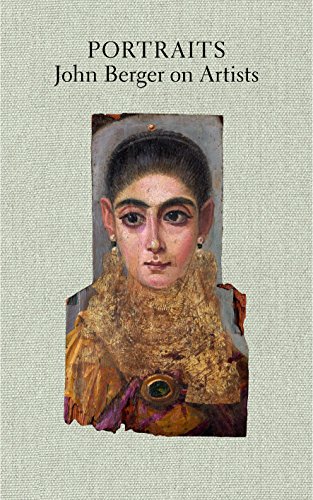
A major new book from one of the world’s leading writers and
art critics John Berger, one of the world’s most celebrated art writers,
takes us through centuries of drawing and painting, revealing his lifelong
fascination with a diverse cast of artists. In Portraits, Berger grounds the
artists in their historical milieu in revolutionary ways, whether enlarging on
the prehistoric paintings of the Chauvet caves or Cy Twombly’s linguistic and
pictorial play. In penetrating and singular prose, Berger presents entirely
new ways of thinking about artists both canonized and obscure, from Rembrandt
to Henry Moore, Jackson Pollock to Picasso. Throughout, Berger maintains the
essential connection between politics, art and the wider study of culture. The
result is an illuminating walk through many centuries of visual culture, from
one of the contemporary world’s most incisive critical voices.
Landscapes: John
Berger on Art 700 BER
With Portraits, world-renowned art writer John Berger took
us on a captivating journey through centuries of art, situating each artist in
the proper political and historical contexts. In Landscapes, a narrative of
Berger’s own journey emerges. Through his penetrating engagement with the
writers and artists who shaped his own thought, Walter Benjamin, Rosa Luxemburg
and Bertolt Brecht among them, Landscapes allows us to understand how Berger
came to his own way of seeing. As always, Berger pushes at the limits of art
writing, demonstrating beautifully how his painter’s eyes lead him to refer to
himself only as a storyteller. A landscape is, to John Berger, like a portrait,
an animating, liberating metaphor rather than a rigid definition. It’s a term,
too, that reminds us that there is more here than simply the backdrop or
‘by-work’ of a portrait. Landscapes offers a tour of the history of art, but
not as you know it.
A collection of essays by John Berger, who is as usual
provocative and thought provoking. He has a unique way of looking at art that
forces us to engage with art on a different level.
The success and
failure of Picasso
759 PIC
759 PIC
In this classic of art criticism, one of our foremost
cultural historians grapples with the life and work of one of the twentieth
century's most mercurial and prodigious artists. In The Success and
Failure of Picasso, John Berger places the artist in the historical, social and
political contexts that made his work possible.
Migrant
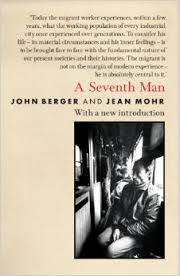
Workers in Europe 301.55 BER
Why does the Western world look to migrant labourers to
perform the most menial tasks? What compels people to leave their homes and
accept this humiliating situation? In A Seventh Man, John Berger and Jean Mohr
come to grips with what it is to be a migrant worker the material circumstances
and the inner experience and, in doing so, reveal how the migrant is not so
much on the margins of modern life, but absolutely central to it. First
published in 1975, this finely wrought exploration remains as urgent as ever,
presenting a mode of living that pervades the countries of the West and yet is
excluded from much of its culture.
John Berger writes: 'The pocket in question is a small
pocket of resistance. A pocket is formed when two or more people come together
in agreement. The resistance is against the inhumanity of the new world
economic order. The people coming together are the reader, me and those the
essays are about - Rembrandt, Palaeolithic cave painters, a Romanian peasant,
ancient Egyptians, an expert in the loneliness of certain hotel bedrooms, dogs
at dusk, a man in a radio station. And unexpectedly, our exchanges strengthen
each of us in our conviction that what is happening to the world today is
wrong, and that what is often said about it is a lie. I've never written a book
with a greater sense of urgency.'
A jar of wild flowers
: essays in celebration of John Berger 828.91409
GUN
In this collection of essays on the work of, and
conversations with, John Berger, thirty-seven of his friends, artistic
collaborators and followers come together to form the first truly international
and cross-cultural celebration of his interventions. Berger has for decades, through his poetic humanism, brought
together geographically, historically and socially disparate subjects. His work
continues to throw out lifelines across genres, times and types of experience, opening
up radical questions about the meaning of belonging and of community. In
keeping with this spirit and in celebration of Berger, the short essays in A
Jar of Wild Flowers challenge us all to take the brave step from limited
sympathy to extended generosity.
And finally…….
Art, politics and motorcycles - on the occasion of his 90th
birthday, this is an intimate portrait of the late writer and art critic whose
groundbreaking work on seeing has shaped our understanding of the concept
for over five decades. The film explores how paintings become narratives and
stories turn into images, and rarely does anybody demonstrate this as
poignantly as Berger.
Berger lived and worked for decades in a small mountain
village in the French Alps, where the nearness to nature, the world of the
peasants and his motorcycle, which for him deals so much with presence,
inspired his drawing and writing.
The film introduces Berger's art of looking with theatre wizard
Simon McBurney, film director Michael Dibb, visual artist John Christie,
cartoonist Selçuk Demiral and photographer Jean Mohr, as well as two of his
children - film critic Katya Berger and the painter Yves Berger.
The prelude and starting point is Berger's mind-boggling
experience of restored vision following a successful cataract removal surgery.
There, in the cusp of his clouding eyesight, Berger re-discovers the
irredeemable wonder of seeing. Realised as a portrait in works and collaborations, this creative
documentary takes a different approach to biography, with Berger leading in his
favourite role of the storyteller.
Nakedness reveals itself. Nudity is placed on display. The
nude is condemned to never being naked. Nudity is a form of dress.
Men act and women appear. Men look at women. Women watch
themselves being looked at.
Glamour cannot exist without personal social envy being a
common and widespread emotion.
Friday, 30 September 2016
If you liked "This is Now: Film and Video after Punk (1978-85) check out the books which influenced the Artists
As you may be aware, The
Gallery is hosting This is Now: Film and Video After Punk
(1978-85), which was opened last week by exhibition curator
Nicole Yip, Director of LUX Scotland.
As a direct result of the exhibition,
the Library has purchased a number of books which highly influenced the work of
the Artists on display. The books are available to borrow from the Library.
"While the eyes may
lead to the soul, the mouth exposes the vitality of the body. Examining the
movements of the mouth, or what LaBelle terms "micro-oralities,"
Lexicon of the Mouth considers the relation of voice and mouth, suggesting that
the importance of voicing is inextricably bound to the exertions of the oral.
Laughter, whispering, singing, burping and self-talk, among many others,
feature as choreographies by which to gauge the exchange of self and
surrounding. LaBelle argues for a more attentive view onto voice by expanding
appreciation for how whistling links us to animals, coughing ruptures all
possibility for speech, and the inner voice, or "unvoice", operates
as a shadow-body. Subsequently, assumptions around voice are unsettled, reminding
discourses surrounding the performativity of the body, and the politics of
speech, of the acts of the tongue, the lips and the glottis as primary
negotiations between interior and exterior"-
A groundbreaking
contribution to debates on women's oppression and consciousness, and the
connections between socialism and feminism. Examining feminist consciousness
from various vantage points - social, sexual, cultural and economic - Sheila
Rowbotham identifies the social conditions under which it developed, showing
how the roles women take on within the capitalist economy have shaped ideas
about family and sexuality.
In this first
installment of acclaimed music writer David Toop's interdisciplinary and
sweeping overview of free improvisation, Into the Maelstrom: Music,
Improvisation and the Dream of Freedom: Before 1970 introduces the philosophy
and practice of improvisation (both musical and otherwise) within the
historical context of the post-World War II era. Neither strictly
chronological, or exclusively a history, Into the Maelstrom investigates a wide
range of improvisational tendencies: from surrealist automatism to
stream-of-consciousness in literature and vocalization; from the free music of
Percy Grainger to the free improvising groups emerging out of the early 1960s
(Group Ongaku, Nuova Consonanza, MEV, AMM, the Spontaneous Music Ensemble); and
from free jazz to the strands of free improvisation that sought to distance
itself from jazz. In exploring the diverse ways in which spontaneity became a
core value in the early twentieth century as well as free improvisation's
connection to both 1960s rock (The Beatles, Cream, Pink Floyd) and the era of
post-Cagean indeterminacy in composition, Toop provides a definitive and
all-encompassing exploration of free improvisation up to 1970, ending with the
late 1960s international developments of free music from Roscoe Mitchell in
Chicago, Peter Brotzmann in Berlin and Han Bennink and Misha Mengelberg in
Amsterdam.
This is a superb
collection of interviews with some of the most significant and influential
names in art, architecture, film, music, history, literature and philosophy
from the 20th and 21st centuries. Since 1993, renowned curator, writer,
cultural instigator, professional conversationalist - and currently Co-director
of Exhibitions and Programmes and Director of International Projects at the
Serpentine Gallery in London - Hans Ulrich Obrist has been conducting
interviews with some of the most significant architects, artists, filmmakers,
historians, musicians, philosophers, and writers of the 20th and 21st
centuries. "Interviews Volume 2" brings together 70 interviews, taken
from an archive of nearly 2,000 hours of recordings that reveal an intellectual
geology of the last 100 years. Encyclopaedic in scope and intimate in tone,
these exchanges produce an array of biographical trajectories, cultural
experiments, theoretical adventures, unrealized projects, and unknown
epiphanies.
Christine de Pizan
(c.1364 1430) was France's first professional woman of letters. Her pioneering
Book of the City of Ladies begins when, feeling frustrated and miserable after
reading a male writer's tirade against women, Christine has a dreamlike vision
where three virtues Reason, Rectitude and Justice appear to correct this view.
They instruct her to build an allegorical city in which womankind can be
defended against slander, its walls and towers constructed from examples of
female achievement both from her own day and the past: ranging from warriors,
inventors and scholars to prophetesses, artists and saints. Christine de
Pizan's spirited defence of her sex was unique for its direct confrontation of
the misogyny of her day, and offers a telling insight into the position of
women in medieval culture. THE CITY OF LADIES provides positive images of
women, ranging from warriors and inventors, scholars to prophetesses, and
artists to saints. The book also offers a fascinating insight into the debates
and controversies about the position of women in medieval culture.
En Abime explores
listening and reading as creative and critical activities driven by memory and
return, reshaped into the present. It introduces an idea of aural landscape as
a historically defined cultural experience, and contributes with previously
unexplored references to the emerging area of listening as artistic practice,
adopting an expansive approach across poetry, visual art and literature. -
poetic, incisive, grounded in politics and history yet continually pushing at
the edges of what we now consider to be sound. She interrogates notions of
music and the shifting experience that is silence with a freshness and
coherence that is inspiring David Toop, Author of Ocean of Sound, Haunted
Weather and Sinister Resonance - compulsive and fast, rushing with you through
textual territories that seem spoken, direct and contemporary while being
nostalgic - invoking a past that creates the present tense. Salome Voegelin,
author of Listening to Noise and Silence: Towards a Philosophy of Sound Art
Although family values
are frequently lamented for being in decline, our society continues to be
structured around the nuclear family. The Anti-Social Family dissects the
network of household, kinship and sexual relations that is the dominant family
form in advanced capitalist societies. This now classic book explores the
personal and social needs that the family ideally meets but more often denies.
Finally the authors propose a moral and political practice directed beyond the
family towards more egalitarian caring alternatives.
Sex, or the Unbearable
is a dialogue between Lauren Berlant and Lee Edelman, two of our leading
theorists of sexuality, politics, and culture. In juxtaposing sex and the
unbearable they don't propose that sex is unbearable, only that it unleashes
unbearable contradictions that we nonetheless struggle to bear. In Berlant and
Edelman's exchange, those terms invoke disturbances produced in encounters with
others, ourselves, and the world, disturbances that tap into threats induced by
fears of loss or rupture as well as by our hopes for repair. Through virtuoso
interpretations of works of cinema, photography, critical theory, and
literature, including Lydia Davis's story "Break It Down" (reprinted
in full here), Berlant and Edelman explore what it means to live with
negativity, with those divisions that may be irreparable. Together, they
consider how such negativity affects politics, theory, and intimately felt
encounters. But where their critical approaches differ, neither hesitates to
voice disagreement. Their very discussion-punctuated with moments of
frustration, misconstruction, anxiety, aggression, recognition, exhilaration,
and inspiration-enacts both the difficulty and the potential of encounter, the
subject of this unusual exchange between two eminent critics and close friends.
Previously unpublished
script for Robert Morris' installation "Hearing," first exhibited at
Leo Castelli Gallery in 1972.
Dan Graham's Rock My
Religion (1982--1984) is a video essay populated by punk and rock performers
(Patti Smith, Jim Morrison, Jerry Lee Lewis, and Eddie Cochran) and historical
figures (including Ann Lee, founder of the Shakers). It represented a coming
together of narrative voice-overs, singing and shouting voices, and jarring
sounds and overlaid texts that proposed a historical genealogy of rock music
and an ambitious thesis about the origins of North America's popular culture.
Because of its passionate embrace of underground music, its low-fi aesthetics,
interest in politics, and liberal approach to historiography, the video has
become a landmark work in the history of contemporary moving image and art; but
it has remained, possibly for the same reasons, one of Graham's least written
about works--underappreciated and possibly misunderstood by the critics who
otherwise celebrate him. This illustrated study of Graham's groundbreaking work
fills that critical gap. Kodwo Eshun examines Rock My Religion not only in
terms of contemporary art and Graham's wider body of work but also as part of
the broader culture of the time. He explores the relationship between Graham
and New York's underground music scene of the 1980s, connecting the artistic
methods of the No Wave bands--especially their group dynamics and relationship
to the audience--and Rock My Religion's treatment of working class identity and
culture.
Little Labors is a
slanted, enchanted literary miscellany. Varying in length from just a sentence
or paragraph to a several-page story or essay, Galchen's puzzle pieces assemble
into a shining, unpredictable, mordant picture of the ordinary-extraordinary nature
of babies and literature. Anecdotal or analytic, each part opens up an odd and
tender world of wonder.
This is Now: Film and Video After Punk (1978-85), which runs
until Wednesday 26 October, also encompasses a programme of free talks and film
screenings that are listed on the listed on the website. Booking for these
events is recommended.
Subscribe to:
Posts (Atom)